| OBJECTIVE | Design and construct a DC, self-excited, series motor |
| MATERIALS/TOOLS | BalsaCopper Wire (20 gauge)Copper sheets (24 gauge)Scooter bearingsPower Supply |
| TIMELINE | September 2015 |
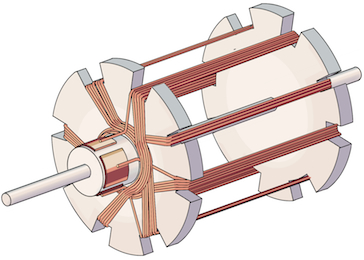
| Progression |
Near the end of my UROP (undergraduate research opportunity) with the Electric Vehicle Team over the summer, one of my supervisors recommended that I read a book on electric motors called Electric Motors and Drives: Fundamentals, Types, and Applications by Austin Hughes and Bill Drury. It was a really interesting read, and it inspired me to try designing my own motor. I knew I wanted to make a DC motor - I had access to DC power supplies - and decided to use field windings instead of permanent magnets because then I would be able to test and adjust the field strength if I needed to. I then resolved to first try making my motor self-excited, and a series motor. I figured that if it worked out well enough, I could make the adjustments neccessary to convert it into a universal motor and run AC currents through it - if that was the way I wanted to go.
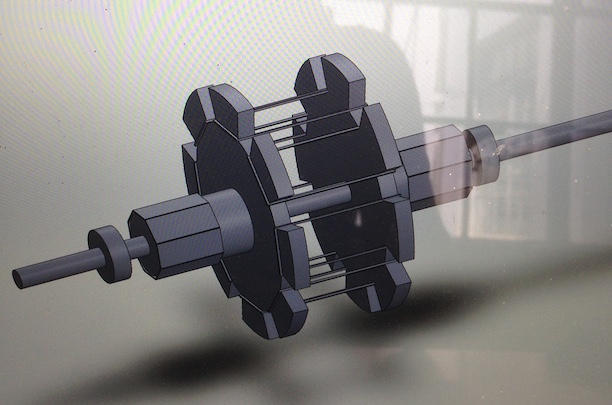
(The mock-up of the motor's rotor, on SolidWorks)
I began designing the physical layout of the motor. The design I settled on ultimately had me deciding to increase torque at the expense of the magnetic field strength (becuase of the distance between the coils of the field windings).
(The construction of the motor, the application of the field windings and armature windings, and the commutator connections)
In initial testing of the motor, I found that it wasn't able to spin. There were two issues in the first run that led to this: 1.) The coating on the commutators The commutator segments were acting more like insulators than a conductors, which was unexpected given that they were made of copper. After using sandpaper to grind off the top layer of the segments, though, it was significantly better at handling currents being passed through it. The copper sheet probably just had an enameled coating on it. 2.) The strength of the magnetic field As both experimentation and my calculations showed, 10 coils per each field winding coil was not enough to produce a strong enough magnetic field. This was a significant problem. Rather than resort to permanent magnets, I deduced a reasonable amount of wire to add to the field windings and moved onto a second attempt.